
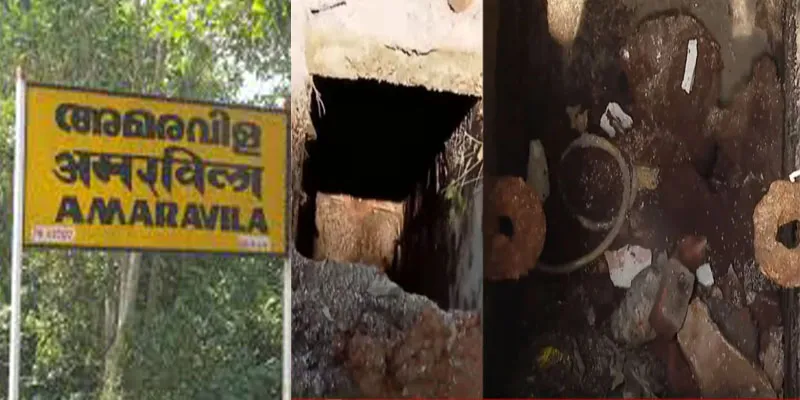
Underground chamber found in Amaravila. Historians have concluded that it may be an underground chamber used to keep duty money secretly before the British rule. It is estimated that the chamber may belong to the period of Marthanda Varma or later. This is when soil is changed on the back side of the earth. The tunnel is closed with an iron plate. It is suspected to be years old. It is informed that the Department of Archeology will inspect the place. It is at a level where only one person can descend. No information is available on who made it
The underground chamber was discovered when the field was cleared during preparations to lay the foundation stone for the new range office building. The chamber is rectangular with handles for lowering. Locals have doubts whether it is an underground passage, a toilet or a chamber. The old-timers say that there was an excise office here even before independence. This is confirmed by the conclusion of the historians. Historian NG Sasibhushan says that it was not a secret chamber used to store money or important documents before the British occupation. Black, tobacco and liquor were the main customs duties of that time. It is concluded that this may be a chamber used to store duty money. Such chambers have been found earlier in the Travancore area.
Amaravila is a village in Neyyatinkara town of Thiruvananthapuram district. The word “Amaravila” means “land of immortality”. This area belongs to Neyyattinkara taluk. The region is characterized by small hills and streams. History suggests that the place name Amaravila is derived from the word Amaravila (plant where the gods lived). The people of this land had migrated here two hundred years ago
Amaravila is the second largest check post in Kerala after Walayar. The village is located on NH 47, 3 km from Neyyatinkara town on the way to Kanyakumari on the Kerala-Tamil Nadu border. The town is known for its religious diversity and is home to a Ganesha temple and a mosque (Amaravila Juma Masjid) on Narayanapuram Street. A Christian Church (CSI Church) stands next to each other. The village has a post office, village office, sub registrar office, Akshaya e-centre and excise office. Located on the banks of the Neyyar, the village has a lot of agricultural land, including paddy and banana. Neyyar river makes this land more fertile. A government tile factory is also located in this village.
Antiquity refers to the time before the Christian era. As mentioned earlier, the history of Kerala can be traced back to 4000 BC when the Proto Australoid and Negrito race inhabited the land. Microlithic artifacts dating back to 4000 BC have been found in Kozhikode. Megalithic monuments such as various types of burial stones, vessels and some man-made underground chambers have also been found. By 3000 BC, Kerala had trade relations with the Indus Valley Civilization and exported spices and goods such as sandalwood, ivory, teak, etc. to the West.
Kerala had a significant place in the commercial map of the ancient world. It is believed that the peacock, monkey, ivory and spices that King Solomon received were imported from Kerala. The Dravidians migrated from the Mediterranean region to South India around 700 BC. Aryans entered Kerala from North India around 300 BC. Buddhism spread in Kerala from 270 BC to 240 BC.