

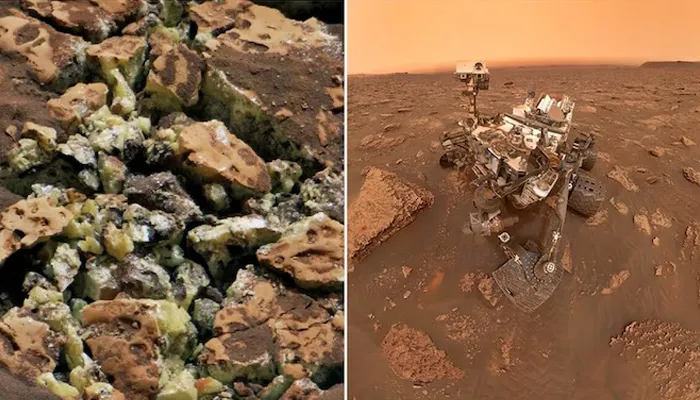
Mars has always been a place that surprises scientists. Crystals have now been discovered on Mars amid tests to search for life rays. NASA scientists have found crystals on Mars that lead to the conclusion that there was water on Mars. Following this, it has been decided to pay more attention to research related to this. The researchers also said that this is the first time that crystals have been found on the planet. Researchers have noticed small rocks formed by many crystals. This is a discovery that could be very important for the study of Mars. Researchers hypothesize that these are formed by pure sulfur particles.
On May 30, the rover captured the images of the crystals. They are yellow in color. It has already been reported that there are traces of sulfur on Mars. After this, crystals with sulfur particles are noticed. NASA has been trying to find sulfur-rich areas on Mars since October last year. The researchers say that the new discovery also reveals the ancient landscape of Mars. Crystalline rocks are formed in a similar fashion to coral reefs found in the oceans. It is estimated that there was once water flowing on Mars, and as a result of this, the crystalline rocks are formed by sulfur.
NASA, the American space agency, has released more information about the presence of water on Mars. NASA’s Mars mission Perseverance Rover has found crucial information about this. It is reported that the remnants of a lake on the surface of Mars (a ooze caused by the presence of water) have been found. The study, released on Friday, detailed the presence of a lake on the Martian surface, dubbed the Jerezo Crater.
The research, led by teams from the University of California, Los Angeles (UCLA) and the University of Oslo, was published in the journal Science Advances. A Reuters report points out that the study makes the crucial discovery that Mars, which currently has a cold climate of minus 225 degrees Celsius and is dry and lifeless, was once warm, wet and possibly habitable. Studies indicate that the Jerezó Crater and its delta contain water-bearing soil sediments, similar to lakes on Earth.
The study shares critical information by analyzing the Perseverance rover’s experiments digging into the Martian surface, as well as previously captured images and other data. The Perseverance rover conducted the experiments by digging about seven feet deep into the Martian surface and collecting samples. Waves from the rover’s RIMFAX radar instrument probed rock layers as deep as 65 feet (20 meters), the report said, citing UCLA scientist David Page. Scientists believe that the samples collected by Perseverance will enable a closer examination of the remains of Jerezho, which is thought to have formed about 3 billion years ago.