
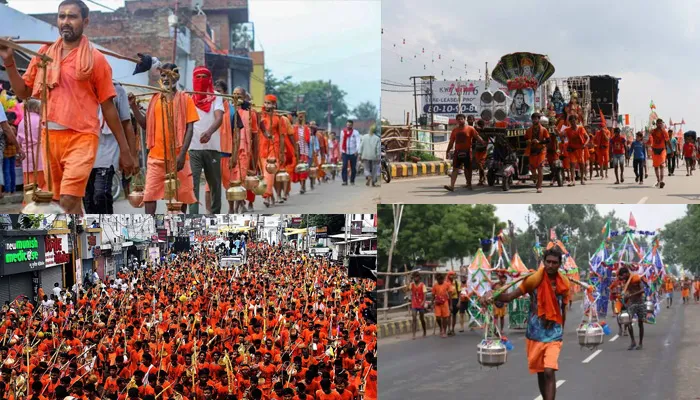
Kanwar Yatra is a religious pilgrimage performed by a sect of Hindus. It is a journey where water is collected from a holy source in a small jug and hung on both sides of a pole. The source of water is often the Ganges. It is a festival completely dedicated to Lord Shiva. History has it that English travelers in the early 19th century saw Kanwar pilgrims at various places during their travels in the northern Indian plains. The historic Kanwar pilgrimage route is filled with images and idols of Varaha Murthy, Bhagavadhwajas and images with Om written on them.
Shops along the Kanwar pilgrimage routes, including hotels, are decorated with Varaha figures. Chants of ‘Jai Bholenath’, ‘Har Har Mahadev’ and ‘Om Namo Narayana’ fill the shops on the root. Mahant Yashwar Maharaj of the Yoga Sadhana Ashram in Muzaffarnagar had requested shopkeepers to put up symbols of Hindu religion in their shops. The assumption is that by installing such symbols, pilgrims can choose hotels and shops that operate in a manner that does not disturb the sanctity of the pilgrimage.
According to Hindu mythology, Varaha Murthy is the third incarnation of Lord Vishnu. When the demon Hiranyaksha submerged the earth, Lord Vishnu took the form of a giant wild boar. This is the incarnation of Varaha Murthy. This Varaha Murti killed Hiranyaksha. After that Varaha Murti lifted the earth on his horn and restored it to its proper place. Lord Varaha is worshiped as the protector of the earth and the savior of the devotees by this heroic deed. Kanwar Yatra is an important religious pilgrimage where devotees collect holy water from holy places like Haridwar, Gaumukh and Gangotri and offer it to Lord Shiva. This yatra performed by Shiva devotees during the month of Sawan is particularly significant in North India.
As Lord Varaha is recognized as the savior of the earth, worshiping him instills a sense of security and protection in Kanwar pilgrims.Until the late 1980s, the pilgrimage was a small affair undertaken by a few monks and senior devotees. Today, the Kanwar pilgrimage, especially to Haridwar, has become the largest annual religious gathering in India. Around 12 million people have attended this fair every year. Devotees come from states like Delhi, Uttar Pradesh, Haryana, Rajasthan, Punjab, Bihar, Jharkhand, Chhattisgarh, Odisha and Madhya Pradesh.
The word Kanwar or Kavadi has a special association with this avatar. The pole is usually made of bamboo, with two nearly equal weights (Ganga water in buckets) attached to or hanging from opposite ends. Kanwar is carried by balancing the center of the pole on one or both shoulders.Its beliefs are associated with Palazhi Mathavan. At the time of churning, the first thing that came up was the cow dung. When the world began to melt in its heat, Shiva decided to swallow the bull’s poison to save the world. The story goes that when it was swallowed, its evil effects began to affect Shiva and Shiva’s devotee Ravana meditated and brought the holy water of the Ganges with a kanwar and poured it into the Shiva temple at Puramahadev and thus Shiva was saved. Kanwar Yatra is performed as a part of this belief.
Festivals are held in the monsoon month of Shravan (July – August). After taking water from the river Ganges (or other nearby river that flows into the Ganges), pilgrims known as Kanwariyas or Shiva devotees decide to travel barefoot in saffron robes and with their kanwars (using sticks). (pots of water) along various routes of up to 105 km and usually in groups of family members, friends, or neighbors, pour Gangajal to Shiva (Shivalinga) at their own local or other famous and larger Shiva temples.
During the monsoon, thousands of pilgrims collect Ganga water from places like Haridwar, Gangotri or Gaumukh, Ganga’s source glacier, other holy places on the Ganges, Sultanganj and return home. They then use this water to anoint Shiva Lingams in local Shiva temples as a sign of gratitude. Pilgrimages are also made to places like Deoghar, Allahabad and Varanasi in Jharkhand. Shravani Mela is an important festival in Deoghar, Jharkhand, where thousands of pilgrims dressed in saffron fetch holy water from the Ganges at Sultanganj, walking 105 km to offer it to Baidyanath (Shiva). Here till about 1960, the pilgrimage was restricted to a few monks, old devotees and wealthy Marwaris from neighboring towns.