
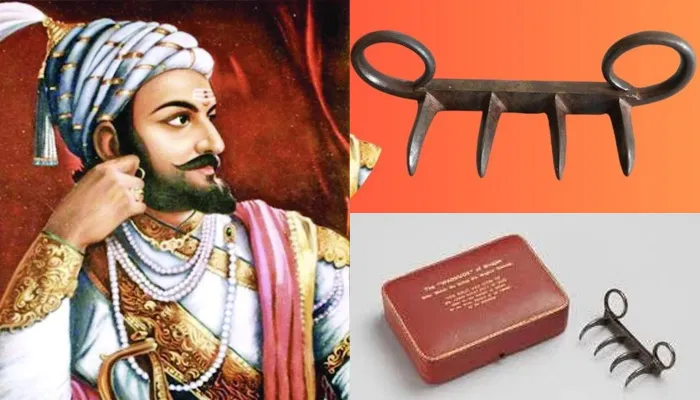
Chhatrapati Shivaji’s legendary weapon ‘Wag Naq’ has arrived in Mumbai from Britain. With this, Prime Minister Narendra Modi is adding light to each link left in the tradition. Shivaji’s Wad Nakh is a weapon that pierced the chest of Afzal Khan, the enemy commander who came to capture the country by killing him in 1659. Shivaji used to hide a sharp deadly weapon like tiger’s claws in his hand. In 1659, Afzal Khan, the general of Bijapur army, tried to kill Shivaji who was summoned for peace talks.
Although Khan, who was taller than Chhatrapati, stabbed Shivaji in the back with a dagger during the embrace, he was not injured as Chatti had anticipated the deception and was wearing armor. But Shivaji, enraged, stabbed Afzal Khan in the shank with the tiger claw-like wag nakh he wore in his hand. Afzal Khan’s chest was replaced.
This weapon was later listed as a valuable treasure and taken away by the British. This secret weapon, which was kept in the Victoria and Albert Museum in Britain, was brought to India under diplomatic pressure. The Wag Nakh was brought from the London Museum to the Mumbai Museum late today, said Maharashtra Culture Minister Sudhir Mungantiwar. The weapon, shaped like a tiger’s claw, is about 200 years old.
The weapon brought from London will be on display at the Chhatrapati Shivaji Museum in Satara in western Maharashtra from July 19. According to the agreement with the Victoria and Albert Museum in London, the Wag Nakh is being exhibited in India for 3 years. Heavy security arrangements have been made in the premises of the Chhatrapati Museum to bring the Vag Nakh to India. Excise and Forestry Minister Sambhuraj Desai had earlier said that the Vag Nak has been given bullet-proof protection and the weapon will be kept at the Chhatrapati Museum for seven months.
A laminated showcase worth Rs 8 lakh has been prepared to display the Wag Nak. There will also be monitoring through CCTV cameras by installing sensors. Massive security arrangements have been made. A special temperature and humidity control system is also provided.London’s Victoria and Albert Museum has officially announced that the Wag Naqh used by Chhatrapati Shivaji Maharaj to kill Afzal Khan will soon be returned.
Britain also says that the Wag Nakh is now needed in India and that this deadly weapon of Shivaji should be displayed in Indian cities. He said that this weapon can lead to new research into history. The authorities said that the Wag Nakh will be delivered to Dubai in November. Wag Naq will arrive under heavy security escort. Maybe there will be a special plane or something to deliver it. London Museum officials said that an agreement has been signed to return the tiger claws to India on the occasion of Chhatrapati Shivaji Maharaj’s 350th coronation day. All four cities in India proposed by the Maharashtra government to display the tiger claws are ready to welcome senior leadership from the Maharashtra government. Britain also decided to implement the decisions in the MoU.
The story of Chhatrapati Shivaji Maharaj’s victory over Afzal Khan, who came to kill him is legendary, so we are happy to bring Tiger Claws back to India,” Maharashtra officials said. “We can’t give fans a bigger surprise on the occasion of Shivaji Maharaj’s 350th coronation day.” It is a natural phenomenon.
The spokesperson said that the MoU is in the first stage of the process. The transfer preparations will be completed in October. The Maharashtra government had also said last week that Wag Nakhi will be brought to Mumbai in November this year.
Shivaji was born in the hill fort of Shivaneri near Junnar city in Pune district. Shivaji Shahaji Bhosle’s real name is Shivaji who formed part of the crumbling Adilshahi Sultanate. This led to the origin of the Maratha Empire. He was officially crowned as Chhatrapati of his empire at Raigad in 1674. Throughout his life, Shivaji engaged in alliances and hostilities with the Mughal Empire, the Golconda Sultanate, the Bijapur Sultanate, and the European invading powers. Shivaji’s military force influenced the Maratha region, captured and built forts and formed the Maratha navy. Shivaji established an efficient and progressive civic administration with well-organized administrative institutions. He revived the ancient Hindu political traditions and rajasabha lineages and encouraged the use of Marathi and Sanskrit rather than Farsi in the rajasbha and administration.