
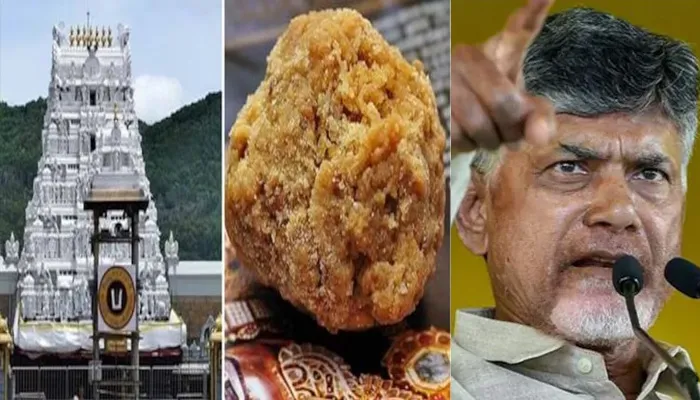
The Tirumala Tirupati Temple is equivalent to Vaikuntha, a temple that every Hindu must visit at least once in their lifetime. What has happened in the temple now has deeply saddened me both as a priest and a devotee, said Ramana Deekshitulu, former chief priest of the Tirumala Tirupati Devasthanam, while expressing his pain over the Laddu controversy.
Responding to the controversy that during the previous government’s tenure, animal fat and low-quality ingredients were allegedly used to prepare the Laddu at the Tirupati Venkateswara Temple, Ramana Deekshitulu, the former chief priest of the temple, expressed his sorrow. “Tirumala Tirupati Temple is believed to be Vaikuntha. Every Hindu should visit this temple on the seven hills at least once in their lifetime. Not only ordinary devotees but kings of the past and today’s rulers have also visited and prayed here. What has happened in the temple now has caused me great distress as both a priest and a devotee,” he said.
“As the chief priest and religious advisor, it is my responsibility to ensure that the deity does not face any discomfort. Many allegations have been raised that the Prasadam is no longer as it used to be. Even though complaints have been made to the TTD (Tirumala Tirupati Devasthanams) about these accusations from devotees, no one has paid attention. This grievous wrongdoing has been happening for the last five years,” he added.
The Laddu distributed as Prasadam to devotees at the Tirumala Tirupati Venkateswara Temple has a history spanning many years. It is said that the Sri Vari Laddu, as it is known, started as a regular offering during the Vijayanagara Empire. The distribution of Laddus at the Tirupati Temple has now completed 309 years. After being offered to Lord Venkateswara, the Laddu is distributed to devotees. The practice of preparing Laddus began on August 2, 1715, at the Tirupati Temple, and since 1803, the Tirumala Tirupati Devasthanam has been offering this Prasadam to devotees. In the past, the Prasadam was distributed in the form of a sweet called Boondi.
Later, ingredients like almonds, cashews, and raisins were added to enhance the flavor and nutritional value. The last update to the ingredients in the Laddu recipe was made in 2001, and it has remained unchanged since then. Every day, 620 people, including 270 chefs, work in the Laddu preparation unit. The recipe for the Tirupati Laddu has only been modified six times in its entire history. According to the 2016 TTD report, the Laddu has a divine fragrance.
Approximately 300,000 Laddus are prepared and distributed every day. The sale of Laddus generates about ₹500 crores annually. The Tirupati Laddu was awarded the GI (Geographical Indication) tag in 2009. It is believed that consuming the Laddu from the Tirupati Temple provides relief from various ailments. Devotees believe that eating this Prasadam enhances physical and mental strength and spirituality.
Governments wearing the mask of secularism are trying to destroy Hindu beliefs. The issue of contaminated Aravana being offered at Sabarimala should also be viewed in conjunction with this. There is a well-planned attempt to weaken the morale of Hindu believers. External forces are also involved in this. The state’s failure to intervene at the right time was part of a coordinated effort. There is a growing demand to identify and take strict action against such forces.