
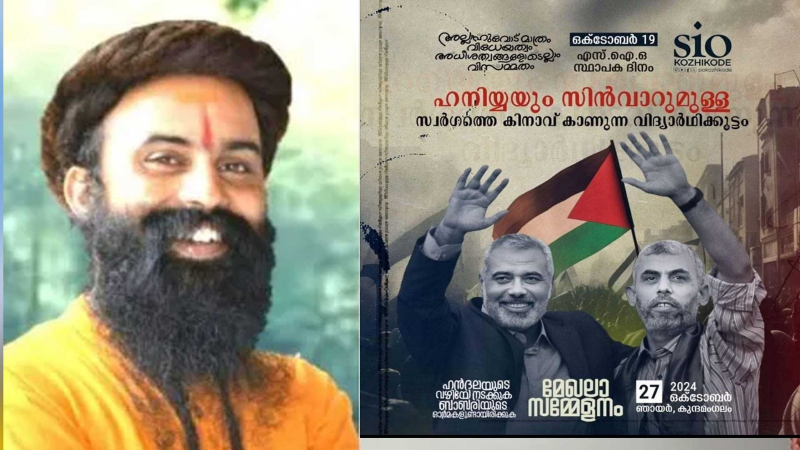
A group of students recently shared a poster featuring two killed Hamas leaders, with a notable message stating that they “dream of joining the Hamas terrorists in paradise.” The poster has sparked concerns, yet under Kerala’s current legal and social framework, there seem to be no restrictions preventing such activities.
The event, planned for October 27 in Kundamangalam, is organized by the Islamic group SIO (Students Islamic Organisation). Their poster further emphasizes submission to Allah and makes references to the memories of Babri Masjid. The mention of the Hamas leaders, Ismail Haniyeh and Yahya Sinwar, has raised alarms as it indicates a dangerous trend among students who idolize these figures and aspire to follow their path.
Swami Dr. Bhargav Ram has commented on the situation, expressing concern over the students’ dream of joining Haniyeh and Sinwar in paradise. He refers to the poster by SIO as an inflammatory piece designed to incite religious fervor and push an extremist agenda. He draws parallels to past incidents of communal unrest, noting that similar displays of fervor were reported during the Moplah rebellion of 1921 and other earlier riots.
Swami Ram warns that this is not merely an expression of religious faith but a calculated preparation for potential violence. He likens the current “hallucination” about jihad to those who believed they were divinely appointed to wage holy wars in the past. He also stresses the need for caution, pointing out that dreams of martyrdom and conflict only lead to further bloodshed and instability, as seen in global terror activities.
The mention of Haniyeh, who was killed in Iran, and Sinwar, who was assassinated in Gaza, is seen as a call for students in Kerala to take up a similar path, which Swami Ram finds highly alarming. He suggests that those who dream of following these figures should instead leave Kerala and join the battlegrounds in Gaza or other conflict zones.
Referring to the SIO’s upcoming conference in Kozhikode on October 27, Swami Ram highlights the potential danger posed by such gatherings. He points out that the references to “walking in the path of Handala” and “remembering Babri” are nothing less than calls for communal unrest and violence. He emphasizes that such provocative language should be taken seriously, as it suggests an imminent plan to create conflict.
Swami Ram also draws attention to the fact that the SIO and SIMI (Students Islamic Movement of India) share similar extremist ideologies. He recalls his earlier warnings to the UP police about the involvement of these groups in the Jamia riots, noting that their links to the Delhi riots and the role of Malayali participants were not properly investigated. He also criticizes the authorities for failing to take action against these organizations.
According to Swami Ram, despite the official ban on SIMI, similar organizations like SIO and PFI (Popular Front of India) continue to operate freely, spreading unrest in society and misleading students. He calls for immediate action to curb such activities through legal measures, emphasizing that the government must control these open displays of extremism.