
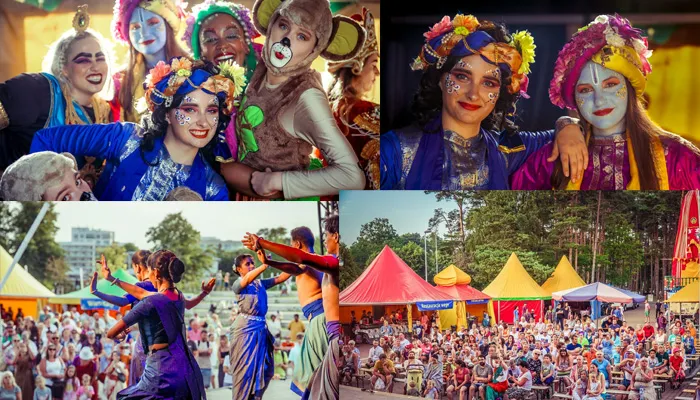
Foreigners organized the Krishna Mahotsav in the European country of Poland, publicly expressing solidarity with India, the birthplace of Sanatana Dharma. The festival was held in 36 different locations across Poland, with each location celebrating for three days. This event is called the “Festival of India.” For over 30 years, foreign devotees of Krishna, part of the Hare Krishna movement, have been organizing this grand festival in Poland. Every year, hundreds of thousands of people, all of whom are foreigners, participate in this celebration. The festival is led by an American monk, Indradyumna Swami.
During this festival, they perform various dramas, dances, bhajans, and recitations about Lord Krishna and Lord Rama, along with distributing delicious food as part of Annadanam. Their goal is to spread the culture of Lord Krishna’s Vrindavan and make others aware of his divine pastimes, thereby bringing everyone closer to devotion to the Lord. It’s important to note that this is not a business for them, but a service. Several booths are set up to teach Indian culture, including booths for mehndi (henna), sari draping, Indian-style makeup, and booths to teach the essence of sacred texts like the Bhagavad Gita and Bhagavatam in Polish. There are also booths selling Indian sweets, dishes, clothing, and jewelry. Foreign women eagerly queue at the sari, mehndi, and jewelry booths to learn how to wear a sari, apply mehndi, and adorn themselves with Indian ornaments.
Their aim is to share knowledge about the soul, the Vedas, the divine, and the solutions to the suffering we experience in life, as found in the Bhagavad Gita and the Bhagavatam. There are numerous brahmacharis (celibate students) and householders teaching this in a simple manner that people can understand in their own language. Every year, tens of thousands of foreigners, from children to elders, participate in this grand festival. Without the help of Indian-origin people, foreigners are teaching other foreigners about Indian culture, which is a victory for Sanatana Dharma.
The Polish Tour is one of the largest cultural festivals in Poland, and the devotees also participate annually in the Polish Woodstock Festival, one of Europe’s largest open-air music festivals. People there love the bhajans about Lord Krishna.
The Ramayana, Mahabharata, Bhagavad Gita, Bhagavatam, and Upanishads have all been translated into Polish, and thousands of people there eagerly purchase these texts. The principles taught in these books are not tied to any particular religion; they are universal truths about life, death, karma, reincarnation, moksha (liberation), and the journey of the soul through different bodies. Sanatana Dharma teaches that life is not meant for conflict but for living with love and peace. Numerous foreign Krishna devotees sing and dance with devotion for the Lord, much like the artists who perform classical music and dance in front of deities in Indian temples.
Additionally, many foreign chefs cook Indian-style food, which is offered to the Lord before being distributed to others. Foreigners also handle photography, videography, stage decoration, washing dishes, driving, and arranging sound and lighting—all as a service to the Lord. The Festival of India is the largest festival organized by foreign Krishna devotees in Poland, affectionately called the “Polish Tour.” Devotees from various parts of Europe come to witness this festival.
Lord Krishna is not the property of any one country or group; he belongs to everyone in this universe. The name “Festival of India” is used because Lord Krishna was born in India, making it easier for others to understand. Their goal is to spread Sanatana Dharma and Krishna devotion worldwide, believing this will bring peace, happiness, and harmony to the entire world.