
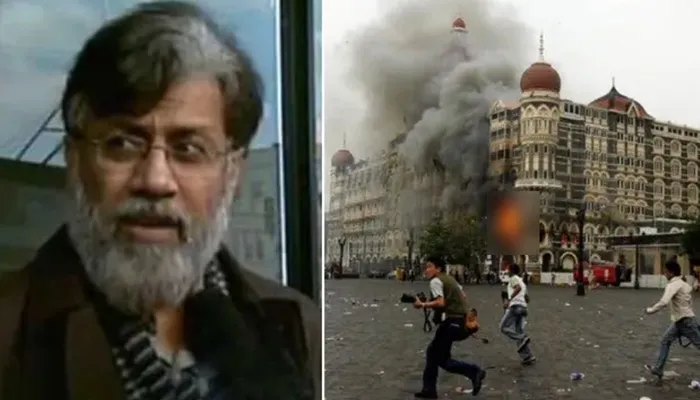
Canadian businessman Tahawwur Rana, the mastermind wanted by India in the Mumbai attack case, will be brought to India soon. US Attorney-PP Cherian informed that Tahawwur Rana should be extradited to India under the extradition treaty. In other words, India had discovered that Rana was the main player in the 2008 Mumbai attacks. Rana arrived in India at the planned time to attack Mumbai and then
returned with special marks where he was to attack . Then the attack took place in those places in India. Upon discovering this, the United States announced that Rana would be extradited to India following India’s request under the Extradition Treaty. The order was given by California Court Judge Jacqueline Choolijian. India has been trying for years to bring Tahawwur Rana to the country and take legal action for his involvement in the attack case.
Rana was arrested by the FBI in Chicago less than a year after the Mumbai terror attacks. Bram Alden, Assistant US Attorney and Head of Criminal Appeals, said that India has every right to extradite Rana. He said that the order of the American lower courts in this regard is correct.
The FBI team had found evidence that Rana and his friend David Coleman Headley had visited various places in Mumbai to carry out the attack and that Rana had provided assistance to the Pakistani terrorist organization. It was decided to hand over Rana to India when he was about to be released from prison after completing his sentence. Although Rana approached the American court against this, the court ruled that India has full right to demand Rana as it falls within the scope of the extradition law.
Rana was running a travel agency in Chicago 15 years ago. He was charged with conspiracy to commit a terrorist attack with David Coleman. 169 people were killed and 239 injured in the Mumbai terror attack. The investigation team also found that Rana and his friend David Coleman Headley visited various places in Mumbai to carry out the attack. It has been decided to extradite Rana to India as he completes his sentence and prepares to be released from prison.
Although Rana had approached the American court against this, the court ruled that India has every right to demand Rana as it falls within the ambit of the extradition law.
Who is Tahawwur Rana?
Tahawwur Rana is a childhood friend of David Headley, who is in prison after being convicted in the Mumbai terror attack case. An American citizen, Headley’s mother is of American origin and his father is of Pakistani origin. In October 2009, the United States sentenced him to 35 years in prison for his involvement in the Mumbai terror attacks.
Headley was convicted of conspiring to bomb strategic centers in India. Headley has been charged with six counts of supporting terrorism in India and murdering US nationals in India. He was also found to be involved in the case of bombing the newspaper office in Denmark.
Rana studied at Hasan Abdul Cadet School in Pakistan, where Headley studied for five years. Rana worked as a doctor in the Pak Army and later moved to Canada and acquired Canadian citizenship.
Tahawwur Rana’s role in the Mumbai attack Later, Punk Rana started a consultancy firm called World Immigration Services in Chicago, USA. It was the Mumbai branch of Rana’s firm that helped Headley target and monitor the Pakistani terror outfit Lashkar-e-Taiba.
On November 26, 2018, Lashkar terrorists stormed Mumbai, the financial capital of the country. The city of Mumbai was under the grip of terrorists for three days. All important places like Taj Hotel, Chhatrapati Shivaji Terminals Railway Station were under the control of terrorists. 166 people, including foreigners, lost their lives in the attack. It was later found that the Pakistani nationals who carried out the attack had reached India by boat.
U.S. attorneys argued that Rana knew Headley had Lashkar connections and helped him cover up terrorist activity. She told the court that she was aware of Headley’s meetings, the topics discussed and even the plans for the attacks, including the destination of the attacks.
The extradition order came after the US government asserted that Rana was part of the conspiracy and had sufficient grounds to charge him with terrorism. Rana was also arrested in October 2009 at the Chicago airport by American police shortly after the arrest of Headley.
A US court acquitted Rana of the serious charge of aiding the Mumbai attacks
In 2011, he was convicted in Chicago of supporting Lashkar terrorists to attack the Danish newspaper Jyllands-Posten, which printed cartoons of the Prophet Muhammad, in 2005. But the US court cleared Rana of the serious charge of abetting the Mumbai attack.
Rana’s contention was that Headley was tricked into planning the attack. The defense argued that Headley, the government’s chief witness, was a habitual offender and a liar. The Department of Justice also assessed that his closeness to authorities was the reason Headley was not sentenced to life in prison in the 2013 case. Headley’s testimony as a government witness led to Rana’s 14-year sentence followed by five years of supervised release.
India has delayed the provisional arrest warrant and extradition request for Rana on the grounds that he will be released after his sentence expires.
What was India’s request In early 2020 , it was decided to release Rana early from the Terminal Island prison in Southern California after he contracted Covid-19. India has delayed the provisional arrest warrant and extradition request for Rana on the grounds that he will be released after the expiry of his sentence. Later, on June 19, Rana was arrested in Los Angeles on India’s request. In 2021, the Biden administration asked a federal court to rule on India’s extradition request.
The court ordered Rana’s extradition to India for trial, despite the lawyer’s objection. Earlier, in 2011, the NIA had filed a charge sheet against nine persons including Tahawoor Rana, Headley, Hafiz Saeed, Lashkar leader Zakhiur Rehman Lakhvi and Al-Qaeda operative Illyas Kashmiri. Apart from them, many Pakistani army officers were accused in the case.