

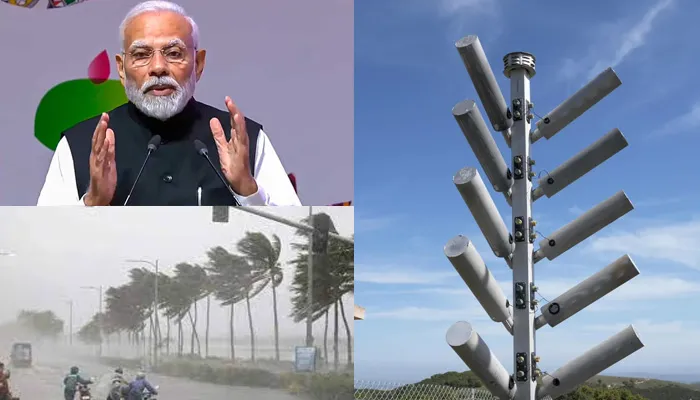
The central government is planning to develop technology to stop heavy rains. The damage caused by heavy rains in the country is unpredictable. Due to extreme rains and landslides, many people have lost their families and become orphans, now the central government is developing technology to stop the heavy rains as well as raining artificially. The cloud seeding experiments are a part of the ‘Mission Mausam’ project initiated by the Union Ministry of Earth Sciences with the aim of making a huge leap in the field of weather monitoring including rain control within 5 years. Rs 2,000 crore has been allocated for research in the first phase of the project. Rain control will be experimented with by increasing the heat inside the clouds to prevent them from becoming raindrops and breaking up the clouds using magnetic fields.
If the project is successful, it will stop the rain and prevent landslides and floods in the areas that receive continuous heavy rains. Researchers believe that along with rain, thunderstorms and hailstorms can also be controlled. M. Ravichandran, Secretary of the Ministry of Earth Sciences, has informed that the 5-year mission will be implemented in 2 phases. The first phase, which will last until March 2026, is to expand the weather monitoring network by installing more, including Doppler radars. The second phase will be observation using satellites and aircraft. To study the processes occurring inside the clouds, a ‘cloud chamber’ will be set up at the Indian Institute of Tropical Meteorology, Pune, the Ministry of Earth Sciences said. Clouds will be created artificially in the laboratory and experiments will be conducted. This will also help in harnessing the potential of cloud seeding.
At the same time, in Wayanad, where there was a huge disaster, it rained in 24 hours, which was a record. When Wayanad faced a big disaster in the landslide, it became clear how much terror the rain had created. And last day, a new study report was released with a warning again in Wayanad. According to the study report of the researchers of the Indian Institute of Science Education and Research, if there is heavy rain in Smalimatta, the epicenter of the Mundakai-Churalmala landslide disaster, another landslide may occur.
According to the report, if the rains are heavy, the loose rocks and soil on the surface of the lake may slide down again. While the government and the people are moving forward with matters related to rehabilitation in Wayanad, the study report pointing to the new risk has been released. The researchers cautioned that adequate precautions should be taken. There may be a situation of strong concentration of Tulamarsha. The shifting rocks and soil may still have a damming effect in the ravine near the Smali Matta. Therefore, the central government is planning to develop a technology to stop the rain so that the people do not face such a situation in the coming days.