
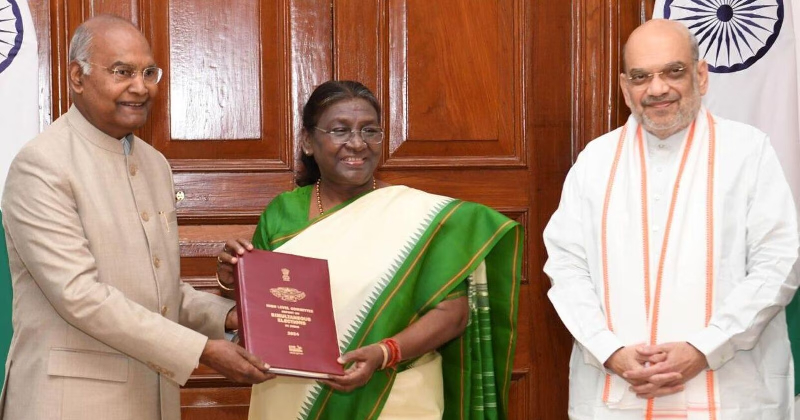
Approval in principle of ‘One Nation, One Election’ Act in India. In another major revolution by the Narendra Modi government, one country submitted the complete draft of an election law to President Droupadi Murmu. It is turning out to be the biggest reform and reform of the democratic process to be planted in the country after independence.
The breaking reports coming from Delhi are as follows.. Today, the high level committee on the topic ‘One Nation, One Election’ submitted its report to President Droupadi Murmu.
Karma News has got some important information about this. Elections should be held simultaneously across the country. According to the report, the committee headed by former President Ram Nath Kovind has a unanimous opinion that the elections should be held simultaneously.
First, Lok Sabha elections and state elections should be held simultaneously, followed by synchronized local elections within 100 days, the report said. Simultaneous elections will change the electoral process and governance. The panel said that this concept can fulfill the aspirations of ‘India, that is Bharat’. The panel also recommended that the Election Commission of India in consultation with the state election authorities prepare a common voter list and voter ID cards. Elections are also held separately.
Prime Minister Narendra Modi has repeatedly spoken about the need for ‘one nation, one election’ and this was part of the party’s manifesto for the 2014 Lok Sabha elections.
Home Minister Amit Shah, former Leader of Opposition in Rajya Sabha Ghulam Nabi Azad, former Finance Commission Chairman NK Singh, former Lok Sabha Secretary General Subhash Kashyap and senior lawyer Harish Salve are the other members of the committee headed by Kovind. The committee was tasked with analyzing and recommending possible solutions related to simultaneous elections in case of defection or any other incident.
Simultaneous polling was the norm in India until 1967, when four elections were held this way. This practice was stopped in 1968-69 with the premature dissolution of some state assemblies. The Lok Sabha was also dissolved for the first time in 1970, a year ahead of schedule, and by-elections were held in 1971. Parliament and legislatures have been dissolved for many years before their terms have expired. The report clearly states what to do in case of such a situation.
The Chief Election Commissioner gave the go-ahead when the position of the Commission was decisive in an election of a country. Chief Election Commissioner Rajeev Kumar has stated that the elections can be held following the instructions in the Constitution and the Representation of the People Act. The commission sees an advantage in reducing the heavy expenditure if the elections are held together. The workload of the officers assigned for election duty will also be reduced. The Commission is of the opinion that more voters will exercise their right in the combined elections and thereby increase the voter turnout significantly. The commission will also have to seek the position of the opposition parties.