

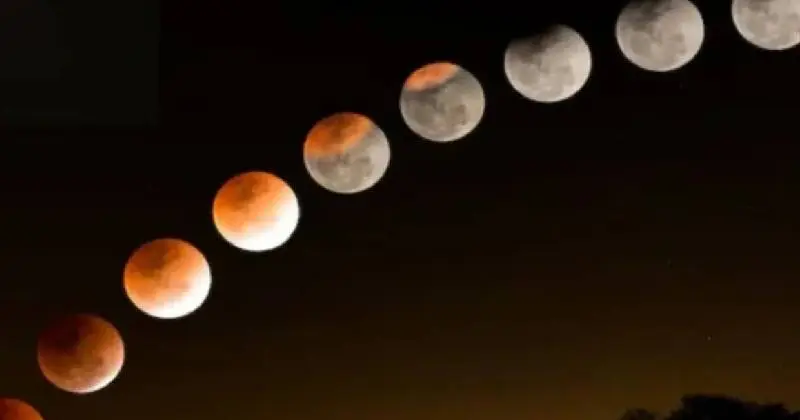
The second lunar eclipse of this year is going to take place on September 18. Scientists from different parts of the world are waiting for the lunar eclipse with great importance. This is the second lunar eclipse to occur worldwide this year. A lunar eclipse occurs when the Earth comes between the Moon and the Sun and casts a shadow on the Moon. It usually darkens the moon and sometimes gives the moon a reddish tint. Lunar eclipses are usually visible everywhere, depending on the weather and time of day. But this lunar eclipse will not be visible in India. People from Europe, America, Africa and some parts of Asia will get a chance to see this lunar eclipse. Lunar eclipse is a phenomenon that can be experienced only during full moon. On a full moon day, the sun and moon come in an approximately straight line between the earth and on either side. On this occasion, the Earth will block the sunlight that should fall on the Moon and the Moon will be in the shadow of the Earth. Thus the phenomenon called lunar eclipse is when the moon falls inside the earth’s shadow. In every full moon, the earth, sun and moon do not come exactly in a straight line, so the shadow of the earth does not fall on the moon and falls a little differently. So not every full moon will have a lunar eclipse. Is it safe to observe a lunar eclipse? The question also arises. Observing lunar eclipse with naked eyes is completely safe. The moon has no light of its own. What the moon does is reflect sunlight. The light from the moon is much less intense and less harmful. During an eclipse its intensity decreases again. So there is no hindrance in viewing the lunar eclipse.
At the same time, the American space agency NASA has come out with a warning that the huge asteroid 2024 ON, which is coming towards the earth, will come close to the earth. An asteroid the size of two football fields is passing by the Earth. It will pass very close to Earth on September 15. Its trajectory is currently being monitored. Although the chances of a threat to Earth are low, NASA is keeping a close watch. It is an asteroid with a diameter of 720 feet. It travels at a speed of 25,000 miles per hour. Even at its closest approach to Earth, there will be a distance of 620,000 miles between 2024 ON and Earth. This distance is 2.6 times the distance between the Earth and the Moon. However, NASA is very cautious as even a small change in the trajectory of the 2024 ON asteroid could have serious consequences for Earth. NASA’s Jet Propulsion Laboratory in California is tracking the trajectory of asteroid 2024 ON. State-of-the-art optical telescopes and radars are used for this. This will allow the Jet Propulsion Laboratory to gather more information about the size, shape, and composition of 2024 ON. The European Space Agency and various universities are collaborating with NASA in studying 2024 ON.